
Scope 3 · Business travel · CSRD

Flight emissions, calculated per actual flight

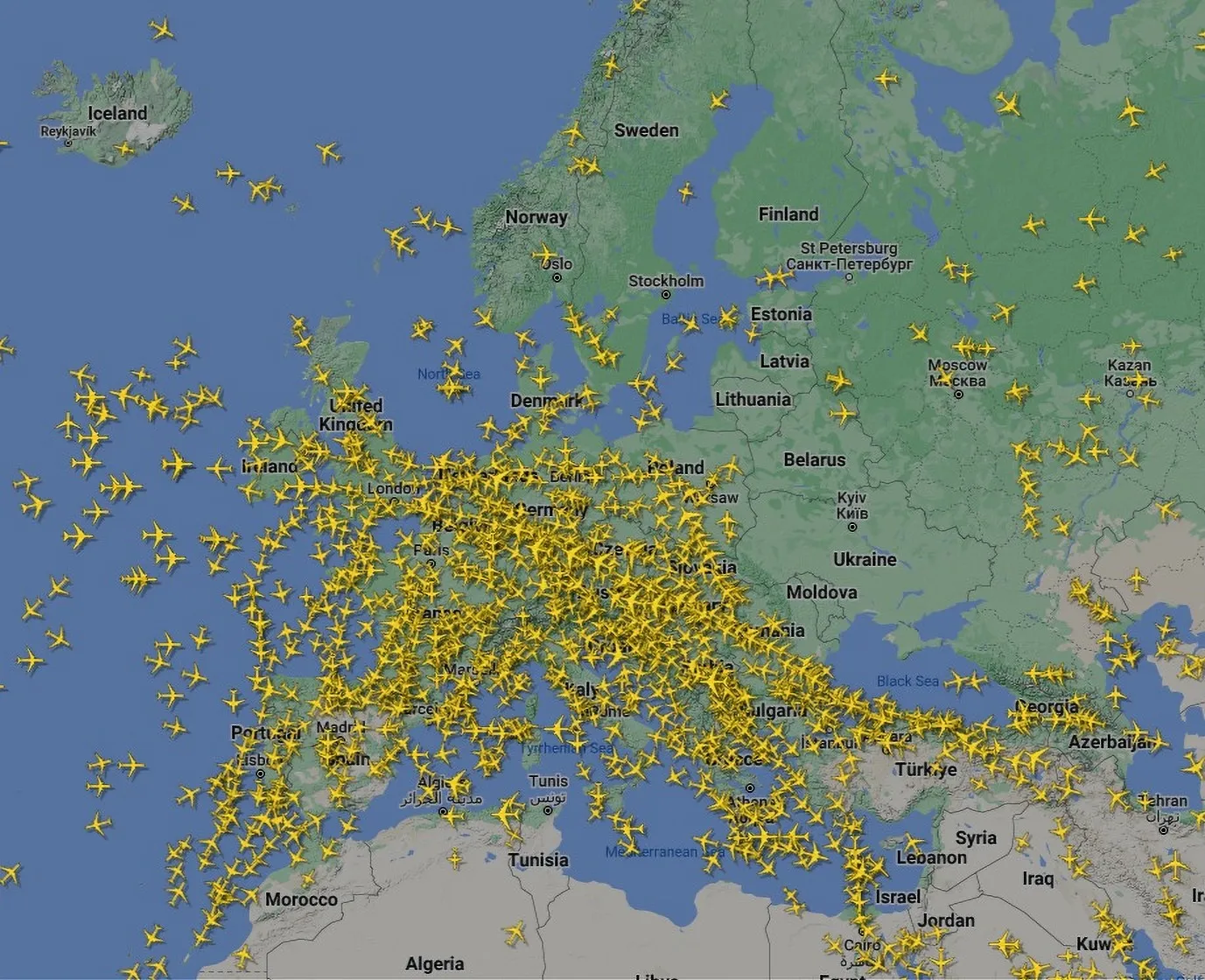
Carbon Compute calculates the CO₂e of business travel flight by flight: the route actually flown, the aircraft that flew it, its cabin and how full it was. The method was developed at KTH and published in a peer-reviewed journal.

SK903BA285LH2420

Why one route, two numbers

The same route can differ by 60 % or more

Distance-based calculators give every flight on a route the same figure. Carbon Compute calculates the flight that actually departed. Five things decide the difference, and each one alone can move the result this much:

  1. up to 17 %

    Seats on board

    A Boeing 737-800 is flown with 162 seats in a two-class layout or 189 all-economy. Same fuel, fewer seats to share it.

  2. up to 20 %

    How full it was

    Low-cost carriers report 84–93 % occupancy; other airlines 76–83 %. Emissions per passenger follow the inverse.

  3. up to 90 %

    Height factor

    Contrails only form above ~8 000 m. A short turboprop flight gets no uplift; a long-haul jet approaches ×1.9.

  4. > 100 % on some routes

    Distance actually flown

    Detours around no-fly zones, weather and congestion. We use the flown track, not the straight line.

  5. varies by type

    Which aircraft flew

    Fuel burn per kilometre differs between types and engine generations. We use the EEA figures for the aircraft that operated the flight.

Read the full explanation →Sources: Schennings, Larsson & Robèrt (2019); Carbon Compute method description.

Carbon Calculator

Every flight, from live data

Our database covers current and historical flights worldwide. For each one we match the aircraft, the operator’s cabin layout and occupancy, and the distance actually flown, then apply the published formula. The result is a figure for that flight, not for an average one.

Published, peer-reviewed method

The method is published and peer-reviewed

The algorithm behind Carbon Compute was developed at KTH Royal Institute of Technology and published in 2019 in the peer-reviewed journal Sustainable Environment Research. The paper is open access, so anyone can read exactly how we calculate.

Development and implementation of an emission optimization model for passenger flight bookings
Andreas Schennings, Joel Larsson, Markus RobèrtSustainable Environment Research (2019) 29:25 · Open access, CC BY 4.0Read the paper · doi:10.1186/s42834-019-0024-5 ↗PDF
Carbon Wiz

From total to action

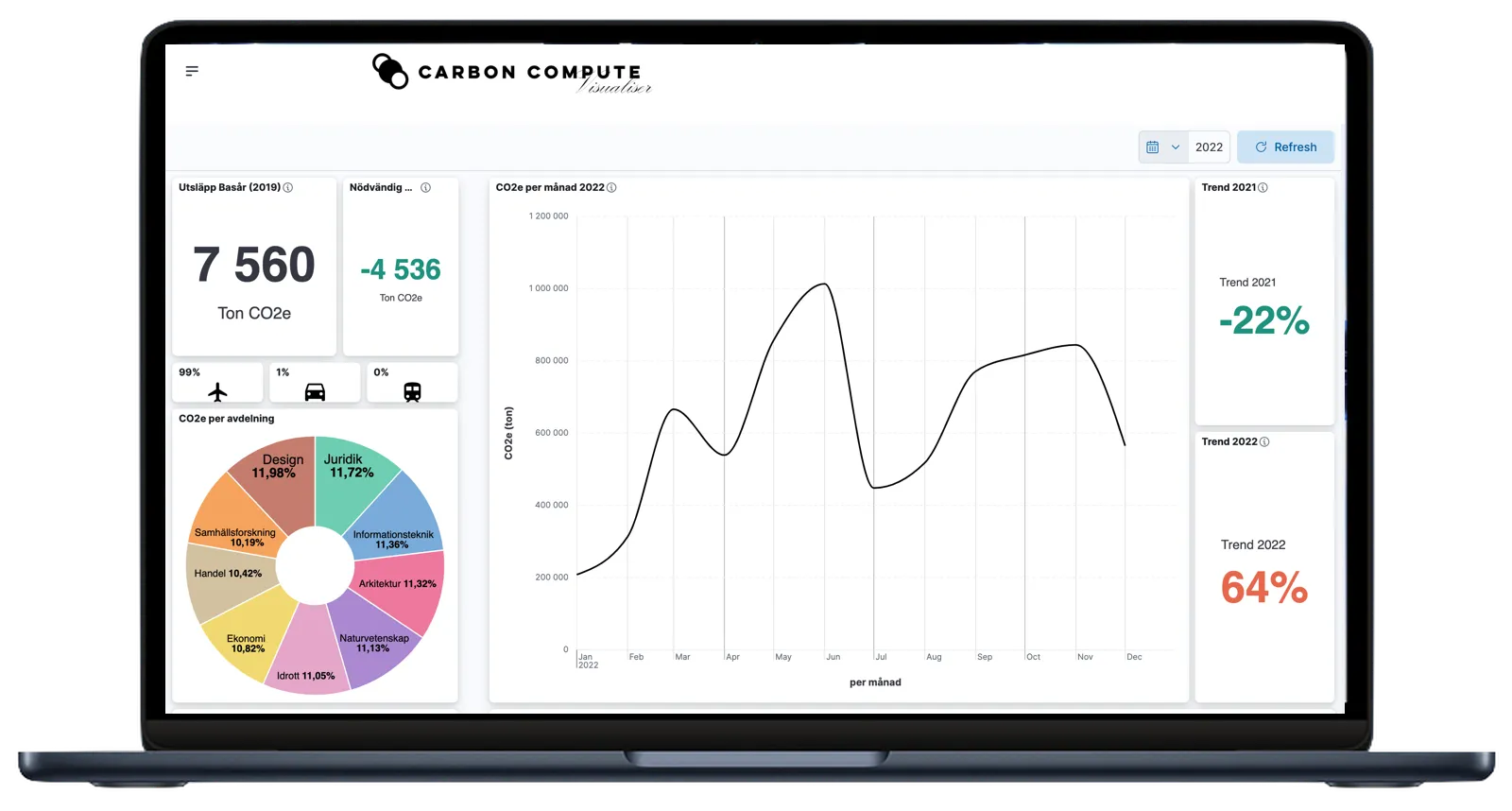
Carbon Wiz shows your organisation’s travel emissions by route, department and trend, against your carbon budget. Drag action cards onto next year’s plan to see what a travel policy would do before you adopt it.

Carbon Wiz – emissions dashboard with trend, per-department breakdown and carbon budget
Built for reporting

Numbers that hold up in a scope 3 report

Business travel is scope 3, category 6 under the GHG Protocol, and one of the few categories where exact data exists for every event. We calculate each flight so the figure is reproducible, not estimated.

  • GHG Protocol scope 3, category 6

    Per-flight, per-passenger CO₂e that aggregates directly into the business-travel category.

  • CSRD / ESRS E1

    Flight-level data and a stated method give the audit trail that limited assurance asks for.

  • Consistent between years

    Versioned factors and a documented height factor, so year-on-year changes reflect your travel, not the method.

  • Height factor, your way

    Reported with the altitude-dependent factor, and CO₂-only alongside for frameworks that count greenhouse gases only.

What the data needs to contain →

Background

Developed at KTH, first deployed on flygresor.se

The algorithm was developed at KTH Royal Institute of Technology and first implemented in 2016 on Sweden’s largest flight comparison site, where it ranked flights by emissions for every search.

  • KTH Royal Institute of Technology
  • SLU – Swedish University of Agricultural Sciences
  • Flygresor.se

Want to know more?

We would be happy to show how Carbon Compute can help your organisation measure and reduce its emissions.